> For the complete documentation index, see [llms.txt](https://help.xaman.app/app/llms.txt). Markdown versions of documentation pages are available by appending `.md` to page URLs; this page is available as [Markdown](https://help.xaman.app/app/getting-started-with-xaman/sending-tokens-from-xumm.md).
# Sending tokens from Xaman
How to send tokens from your XRP Ledger account managed by Xaman
Sending tokens from Xaman (formerly Xumm) is a very easy process. In fact, sending tokens is one of its primary functions! Here is how it's done...
### **Step 1**
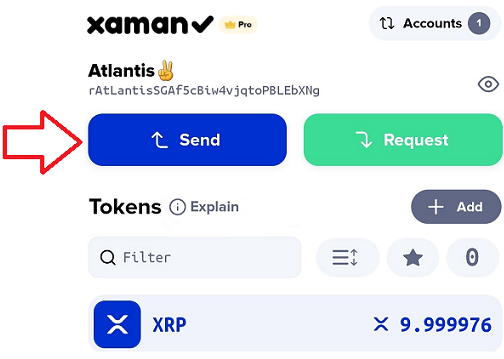
From the main screen in Xaman, press the **Send** button.
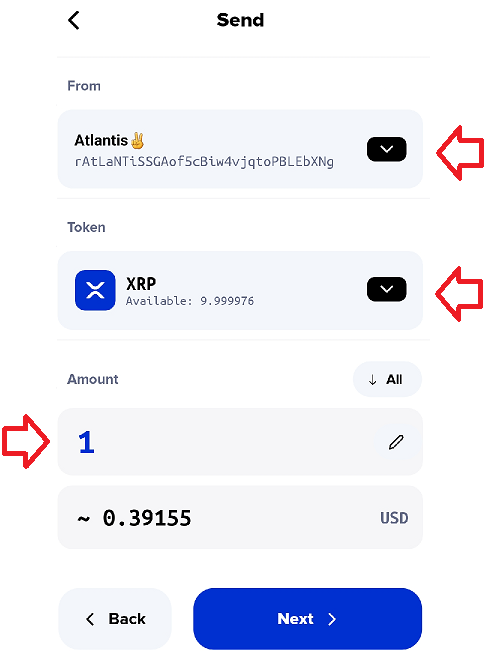
On the next screen, you will see the option to enter the **amount** you would like to send.
(You can also change the account you would like to send the tokens **from** and you can change the **type** of token you would like to send.)
In our case, we are going to send 1 XRP from our account.
Press the **Next** button to continue.
### **Step 2**
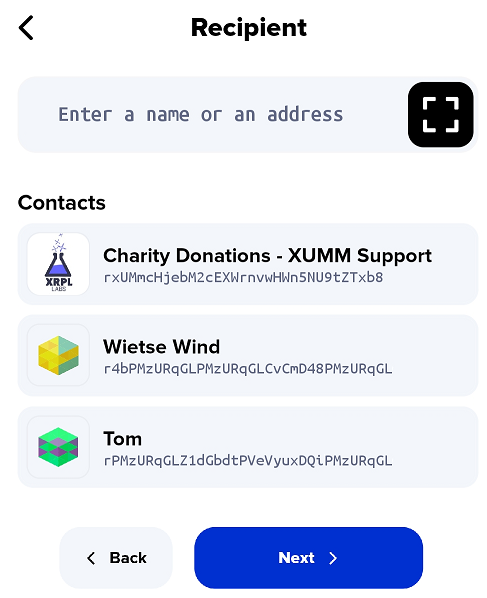
In this screen you can enter the **recipient's** account that you are sending your tokens to.
Keep in mind, there are two types of accounts on the XRPL.
* **Self custodial** accounts - You are solely responsible for managing your private keys.
* **Custodial** accounts - A company is responsible for managing the private keys to their account. (Usually a crypto exchange.) You are assigned an account number with the exchange called a destination tag.
Both types of accounts will have an r-address but a custodial account will also require a destination tag. (More about destination tags later.)
Press **Next** after you have entered/selected the correct destination r-address.
### **Step 3**
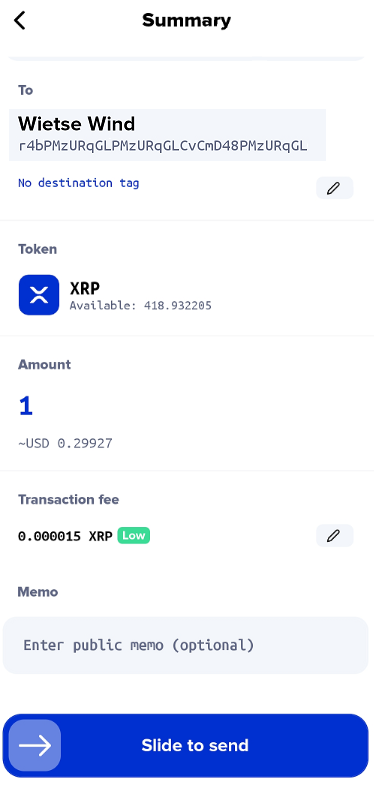
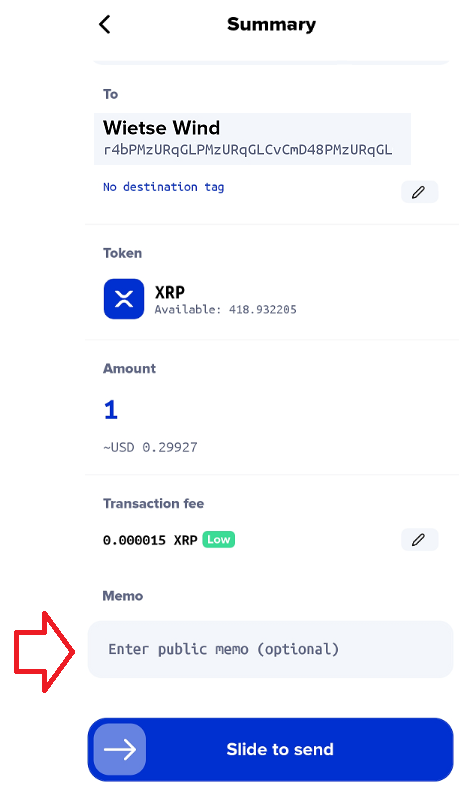
Finally we reach the **Summary** screen. Here you can review your transaction to make sure it is correct.
If you are sending to a self-custodial account, you can simply **Slide to send** and your transaction will be sent to the XRP Ledger to process.
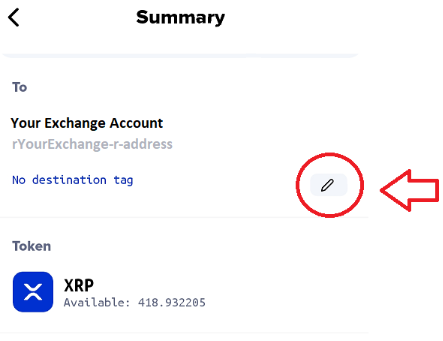
However, if you are sending to a **custodial** account, (ie. an exchange account) this where you would enter your **destination tag**.
{% hint style="success" %}
Remember, self-custodial accounts, like the ones managed with Xaman **do not** require destination tags. Only **custodial** accounts require them.
{% endhint %}
#### **A little bit more about destination tags**
You may have noticed that most crypto exchanges have **one** receiving r-address for **all** of their XRP customers? Have you ever wondered how thousands of customers can use just one XRP account?
When you create an account with a crypto exchange, they issue you a customer account on their internal database. They also create a destination tag which points to your new customer account and they provide you with **their** XRP Ledger account which you can send and receive XRP. You do not own their XRPL account. They have complete control over it. Since thousands of customers are sending funds to and from the same XRPL account, the only way they can tell which funds belong to which customer is by the destination tag included in each transaction.
If you would like to learn a bit more about destination tags, check out this video:
{% embed url="" %}
### Frequently Asked Questions
#### I noticed that there is a 'Memo' field on the Summary screen before I sign the transaction. What is that for?
The Memo field is a location where you can add additional information to a transaction. For example, you might be paying an invoice and you would like to include an invoice number in your transaction. You could add the invoice number in the Memo field.
There are cases where you might want to prove that you own your XRPL account. (ie. Perhaps a crypto exchange or a bank is asking for proof that it is your account.) You could agree to send them a transaction and include a word or phrase that you and the bank agree on in the transaction. You would put the word or phrase in the Memo field.
There are also cases where you might have sent funds to a wrong account and you would like to try to contact the account owner and ask them to return your funds. You could write a short message in the Memo field and explain that the funds were sent by mistake and you would be very happy if they returned your funds to you.
But, please note, the Memo field is **not for a destination tag**. There is a separate field for destination tags. (As explained above.)
---
# Agent Instructions
This documentation is published with GitBook. GitBook is the documentation platform designed so that both humans and AI agents can read, navigate, and reason over technical content effectively. Learn more at gitbook.com.
## Querying This Documentation
If you need additional information that is not directly available in this page, you can query the documentation by asking a question.
Perform an HTTP GET request on the following URL with the `ask` and `goal` query parameters:
```
GET https://help.xaman.app/app/getting-started-with-xaman/sending-tokens-from-xumm.md?ask=&goal=
```
`ask` is the immediate question: it should be specific, self-contained, and written in natural language.
`goal` is what the user is ultimately trying to achieve, the reason they need the answer. Sharing it helps GitBook give you a better, more relevant answer. A goal is most helpful when it describes the outcome the user wants rather than restating the question. For example, with `ask=how do I create an API token`, a goal like `automate deployments from our CI pipeline` lets GitBook tailor the answer to that use case.
The response will contain a direct answer to the question and relevant excerpts and sources from the documentation.
Use this mechanism when the answer is not explicitly present in the current page, you need clarification or additional context, or you want to retrieve related documentation sections.