> For the complete documentation index, see [llms.txt](https://help.xaman.app/app/llms.txt). Markdown versions of documentation pages are available by appending `.md` to page URLs; this page is available as [Markdown](https://help.xaman.app/app/xaman-tangem-cards/creating-a-pin-on-your-xumm-tangem-card.md).
# Creating a pin on your card
How to create a passcode / pin for your Xaman card
{% hint style="success" %}
Note: This article applies to the first generation of Xumm cards. The new Xaman cards have this feature disabled.
{% endhint %}
One of the security features on a Xaman card is the ability to create a passcode or pin. Once enabled, the pin/passcode must be entered in order to sign with the card account.
In certain situations, setting a pin can make a lot of sense.
For example, if you configure your cards as [recommended](/app/xaman-tangem-cards/getting-started.md), you will create a Primary account then set up a second card as a Signing account. This configuration allows you to store your Primary card in safe/secure location while using the Signing account to sign transactions on your Primary account. In this case, assigning a pin to your Signing card adds an additional level of protection in case your card is ever stolen.
### **If you forget the pin...**
There is no recovery feature or 'back door' option to reset a pin so if you forget the pin, you will not be able to use the card to sign transactions. This is why we mentioned that setting up a pin is useful **only in certain situations**. If you configure a signing (backup) card for your Primary account, forgetting your pin is unfortunate, but you can still access your account with the Primary card. You would lose the ability to use the Signing card but you would not lose access to your funds. If you were to configure a pin on a card that has no backup card, you would not be able to access your funds if you forgot your pin.
{% hint style="danger" %}
We strongly recommend that you **only configure a pin** if you have created a **backup card** for your account.
{% endhint %}
### **Setting up a pin**
1. Launch Xaman and press **Settings** -> **Accounts**
2. Press the "**Edit**" button side the card account you would like to add a passcode on.
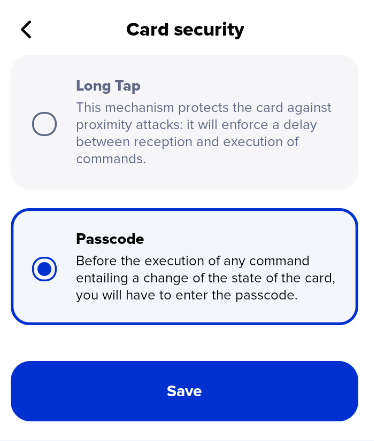
3. Select "**Card enforced security**"
4. Select "**Passcode**"
5. Press the "**Save**" button. You receive the follow warning:\
\
**Notice the warning!**\
\
\
6. Press "**Yes, I'm Sure**"
7. Enter your new passcode and press **Save**.\
\

8. Sign with the card.
---
# Agent Instructions
This documentation is published with GitBook. GitBook is the documentation platform designed so that both humans and AI agents can read, navigate, and reason over technical content effectively. Learn more at gitbook.com.
## Querying This Documentation
If you need additional information that is not directly available in this page, you can query the documentation by asking a question.
Perform an HTTP GET request on the following URL with the `ask` and `goal` query parameters:
```
GET https://help.xaman.app/app/xaman-tangem-cards/creating-a-pin-on-your-xumm-tangem-card.md?ask=&goal=
```
`ask` is the immediate question: it should be specific, self-contained, and written in natural language.
`goal` is what the user is ultimately trying to achieve, the reason they need the answer. Sharing it helps GitBook give you a better, more relevant answer. A goal is most helpful when it describes the outcome the user wants rather than restating the question. For example, with `ask=how do I create an API token`, a goal like `automate deployments from our CI pipeline` lets GitBook tailor the answer to that use case.
The response will contain a direct answer to the question and relevant excerpts and sources from the documentation.
Use this mechanism when the answer is not explicitly present in the current page, you need clarification or additional context, or you want to retrieve related documentation sections.