> For the complete documentation index, see [llms.txt](https://help.xaman.app/app/llms.txt). Markdown versions of documentation pages are available by appending `.md` to page URLs; this page is available as [Markdown](https://help.xaman.app/app/xaman-pro/features-of-pro/profiles/all-about-profiles.md).
# All about Profiles
How does the Profiles feature in Xaman Pro work?
### **What exactly is Profiles?**
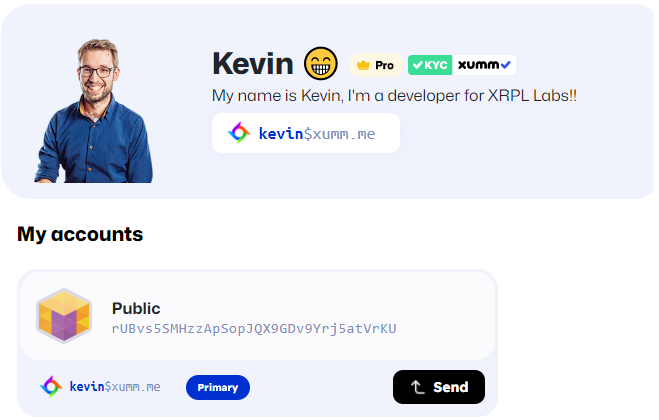
The Profiles feature allows you to create an identity page and PayString so people can easily send you funds and locate your account on the XRPL.
Here’s what a Profile page looks like:
### **Why would I want to create a public Profile on the XRPL?**
It is a pretty cool way to represent yourself and it allows you to control your image in the XRPL community. You get your own personal page on the internet which provides an easy way for people to send you funds.
### **How do I access my Profile page?**
You just need to open your favorite internet browser and enter your Profile page address.
For example, to get to Kevin's page, you would enter:
[xumm.me/kevin](https://xumm.me/kevin)
In your case, your Profile page would match your identity much closer than Kevin's test page. So if your name is John Shepard, your Profile page could be:
xumm.me/johnshepard
or if your name is Daniel Jackson, your Profile page could be:
xumm.me/danieljackson
The general idea is that your Profile page matches your actual identity.
### What is my Paystring?
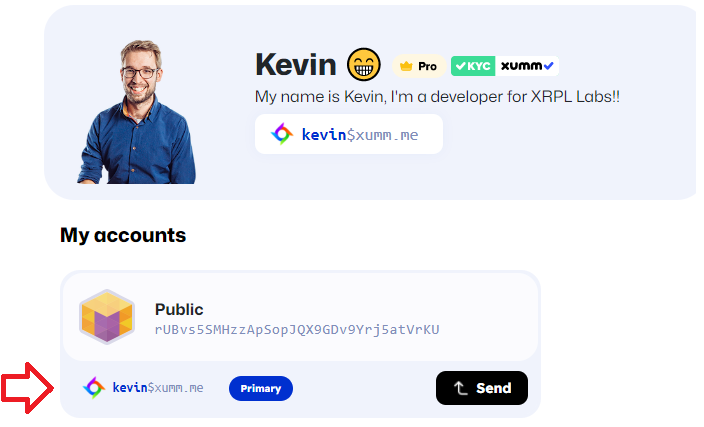
Your PayString address is an easy way for people to send you funds on the XRP Ledger.
In Kevin's case, his PayString is:
kevin$xumm.me
If you wanted to send XRP to Kevin's account, you could always enter his r-address: **rUBvs5S....**
but many people have trouble remembering r-addresses. It is much easier to send the XRP to: **kevin$xumm.me**
Think of PayString like a phone book that links your r-address to an easy-to-remember PayString address.
### How can people find my PayString?
Since all Xaman Profile pages start with: **xumm.me/**\ you could simply tell people how to find your Profile page, or, since all PayStrings end with: \**$xumm.me** your could simply tell them your PayString...but we have taken it one step further.
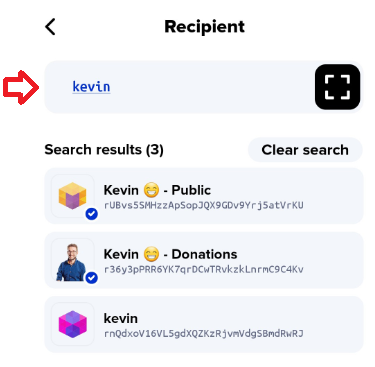
In Xaman, you can actually search for a PayString directly from the Send flow. In this case, we search for "kevin" and Xaman will display the results for you to choose.
It is just like a phone book, you can look up someone's r-address just by knowing their name! 🎉
### How do I create my Profile page?
We have created an article to walk you through the process:
---
# Agent Instructions
This documentation is published with GitBook. GitBook is the documentation platform designed so that both humans and AI agents can read, navigate, and reason over technical content effectively. Learn more at gitbook.com.
## Querying This Documentation
If you need additional information that is not directly available in this page, you can query the documentation by asking a question.
Perform an HTTP GET request on the following URL with the `ask` and `goal` query parameters:
```
GET https://help.xaman.app/app/xaman-pro/features-of-pro/profiles/all-about-profiles.md?ask=&goal=
```
`ask` is the immediate question: it should be specific, self-contained, and written in natural language.
`goal` is what the user is ultimately trying to achieve, the reason they need the answer. Sharing it helps GitBook give you a better, more relevant answer. A goal is most helpful when it describes the outcome the user wants rather than restating the question. For example, with `ask=how do I create an API token`, a goal like `automate deployments from our CI pipeline` lets GitBook tailor the answer to that use case.
The response will contain a direct answer to the question and relevant excerpts and sources from the documentation.
Use this mechanism when the answer is not explicitly present in the current page, you need clarification or additional context, or you want to retrieve related documentation sections.